Recovery of the Barbanel Archive
City of GodThe Recovery of the Barbanel Archive is the hinge on which E. L. Doctorow's City of God turns, the moment when the novel's central quest—undertaken by Thomas Pemberton, the former Episcopal priest known as Pem—finally yields its prize: the hidden diary and documentation of Josef Barbanel, chief assistant to the Kovno Ghetto council leader Dr. Koenig. The recovery transforms Pem from a lifelong observer into a man who has actually done something in the world, reunites Sarah Blumenthal with her father's testimony and a photograph of him as a child runner, and produces documentary proof of the identity of S.S. Major Schmitz, the ghetto commandant. The unsealing of the chest at JFK Airport becomes a scene of quasi-religious intensity, in which the material evidence of the Holocaust is treated as sacred scripture, and the recovered archive sets in motion the legal pursuit of the Nazi war criminal—a pursuit that ultimately ends in frustration when Schmitz dies before he can be brought to justice.
The Quest and Its Origins
The recovery of the archive begins as a self-appointed mission that grows out of Pem's discovery of Joshua Gruen's notebook, which contained the names of people in Vilnius—once Vilna—who had seen or known of the hidden ghetto diary. Finding the archive transformed Pem, as the narrator observes: Eastern Europe slimmed him down, his bulk became more contained if not exactly muscled, he moved more fluidly and looked put together, washed and groomed, perhaps because he had cut his hair and rid himself of the ponytail. The narrator is persuaded that setting off on a quest, a self-appointed mission, and succeeding can surprise a fellow out of his usual humors—that Pem had actually done something. There is a literary template here, the narrator notes, call it Christian knighthood, and the fact that his lady is Sarah Blumenthal, a rabbi, a widow who lives with her two children on the Upper West Side, is what makes it possible. But something darker lurks beneath the chivalric surface: a successful competition with a dead man, Joshua Gruen, whose notebook had provided the names Pem hunted down.
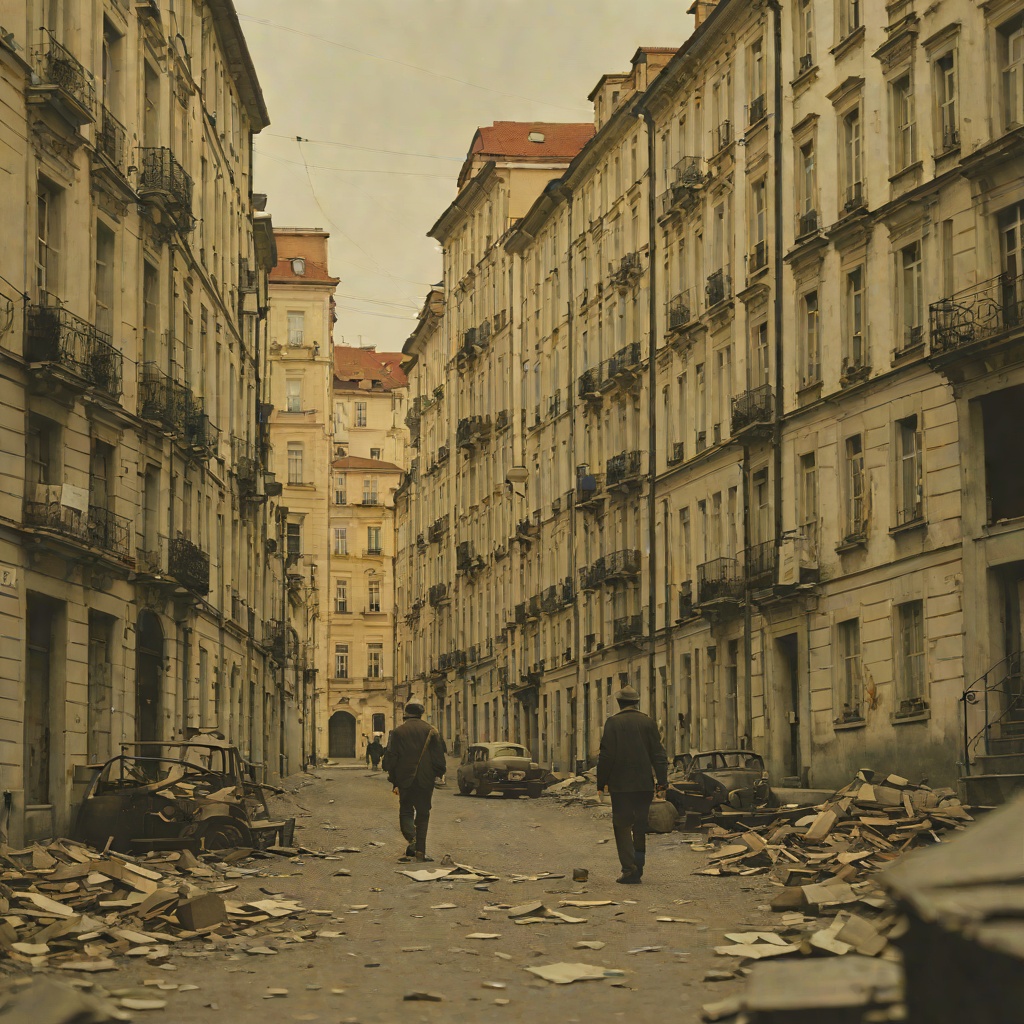
Pem's journey took him to Vilnius, a heavily rebuilt city given World War II and the Soviet taste for high-rises, with the picturesque Neris River winding through it—the same river the narrator's little runner Yehoshua speaks of. Pem took the streetcar that stopped outside his hotel door, and the bell rang and the car swung around corners and the pantograph flashed like lightning, and Pem felt the menace lurking under the town's modernity, the old historic demons with their sharpened pitchforks riding around in the latest-model cars and taking their business lunches in the fine restaurants. He hunted down every name listed in Joshua's notebook and made no headway. The church in which the priest Father Petrauskas had agreed to hide the ghetto diary had long since disappeared; the father himself was no longer alive; the site of the church was now given over to a six-story apartment house with terraces. The chargé d'affaires at the American embassy remembered Pem and arranged an appointment for him with a priest at the office of the Vilna diocese, but that too yielded nothing. The Russians had torn up the city and its German defenders in 1944 and not much was left after that but rubble.
One afternoon, not knowing what it could possibly accomplish, Pem took a cab to the little burned-out synagogue in the poor part of town in front of whose doors Sarah's husband was fatally beaten. The synagogue was being preserved by the city as a ruin. Pem talked to the caretaker, an elderly Lithuanian woman who spoke broken English, and he paid twelve litas to stand inside the doors and see the remnants of dark wood reading desks and pews arranged in a square around a central table. A wrought-iron frame with sconces hung over the room. Sunlight pouring through the fallen-in roof lit up the dust suspended there, motionless, as if set in place permanently by the conflagration of years before.
The Discovery of the Chest
The breakthrough came through the caretaker's son, Josip, a man in his fifties who was, Pem learned, a tile setter, the best in Vilna. Josip told Pem that the Russians had come to loot Father Petrauskas's church and discovered a battered wooden chest that the father kept in the closet of his own room in the rectory, where he slept. The chest was padlocked, sealed with tape and wrapped around with thick rope. The soldiers, with their arms full of candlesticks and silver, called for an officer. When the officer arrived he was unlike the men, he seemed very civilized—he smoked a cigarette with a holder and his uniform was quite clean. Josip was afraid the father would be taken away, but the officer questioned the father politely and the father told the truth—that what was in the chest were writings of Jews. The officer, with a black crayon, wrote a description of the contents in Russian, then signed his name and serial number right there on the top of the chest and ordered the soldiers to remove it without disturbing the seal, and that was the end of the matter.
Pem's training as the Divinity Detective stood him in good stead, he told the narrator. Clearly that had been an intelligence officer questioning the father. The Russians swept up anything that might conceivably be of importance, even though ninety-nine times out of a hundred they would never look at it again. Moscow is a really interesting place right now, Pem said; the vaults of the KGB are like a flea market. It took some time, but they will sell you anything if the price is right. Pem had flown into Moscow, made calls, spoken as a priest to the fathers, a diplomat to the attachés, a con man to the hustlers, flashed his roll, laid on a lot of attitude, and fearlessly penetrated the KGB—though, as he later reflected, they were all like beggars with their hands out, but he did not know that at the time.
The Unsealing at JFK
The chest was impounded at JFK Airport until, at Pem's request, he could get in touch with the Justice Department and have one of their attorneys present when it was cracked open, as customs had insisted it must be. If the archive included documentary proof of the identity of the ghetto commander, S.S. Major Schmitz, it would have to resist a challenge in court, and so the circumstances of the unsealing of the material had to be irreproachable. The arrangements took the better part of two weeks, and then the day came. Pem and Sarah rode out to JFK in a taxi on a late weekday morning in the rain. They did not speak. Sarah used her cell phone to remind her helper, Angelina, that the boys had half a day of school because of a teachers' conference and would have to be picked up at lunchtime. Sarah's raincoat had fallen open, she was wearing a suit, and Pem noticed how well shaped her pantleg was above the knee. The observation directed him to an intent reading through the rain streaks of the color-coded directions along the airport highway. Pem's new triumphalist self-regard was on this morning absent; rising behind his eyes was the old familiar bleakness. It was not that Sarah was not tremendously impressed by what he had done—on the contrary, she seemed to have awakened to him in some way, she seemed to have moved with him into an acceptance of their growing intimacy. But he wondered about his own motives—if he was incapable of an act that did not contain its own corruption. Could this have been at heart no more than a seductive stunt?
Minutes later, in a small office in the International Arrivals Building, Sarah, Pem, a young woman from the U.S. Attorney's office in New York, and various customs people watched as an inspector took up a hammer and chisel and went to work. The chest sat on a steel table. It was larger than Sarah understood from Pem's description—she had imagined it as the size of a footlocker, but it was larger, deeper. It looked homemade, hammered together with big heavy nails and metallic corner pieces. It was painted white, but where the paint had flaked off there was raw lumber. Sarah sat in one of the bridge chairs lining the wall. The customs man found the rusted locks impervious and asked if he could pry off the hasps, which, he warned, would splinter the wood. Without quite realizing the proprietorship she had been granted, Sarah nodded her approval. Yet the sound of the splitting wood made her wince—as if her father's history was seeping into the room.
The hasps were pried off and the thick rope was cut. The attorney took a small camera out of her bag and snapped three or four pictures of the Russian writing across the top of the chest. Then the inspectors moved forward. They carefully lifted out packages of various sizes wrapped in oilskin. There was in addition an oilskin lining against the inner sides of the chest, the fierce preservation of these materials unmistakable and, to Sarah, itself an urgent message that brought a sob to her throat. The inspectors unwrapped the packages to find sheaves of paper bound in twine, booklets, manuals, folders, rolled-up blueprints, diagrams, stapled documents, envelopes of various sizes, each labeled in a small, neat Yiddish script. They opened every packet, every envelope. Then, having run their hands along the inner walls of the chest, they agreed among themselves that there was nothing here of interest to them. They replaced everything, more or less as they found it, and excused themselves.
The Contents of the Archive
Pem and the attorney dove in. In notebooks, students' bluebooks, and unbound pages, there was a diary in one increasingly familiar hand covering a period of three years, 1941 to the date in 1944 when the ghetto was dismantled and the survivors were marched to the railroad station. There were reams of documentation: rules and regulations issued by the Germans, innumerable orders with the signature of Commandant Schmitz, confiscating all domestic animals, then all wagons and, subsequently, all books, typewriters, cameras, candelabra, jewelry. It was forbidden for Jews to be seen on the street after seven P.M., it was forbidden for Jews to possess farm tools, for Jews to assemble more than three together, and so on—everything taken away, little by little, until there was only life left to take away. And then there were testimonies of witnesses about the ways in which that was done. Sarah read some of these and provided stunned summary translations.
In a separately wrapped packet was a complete dossier on Commandant Schmitz—a c.v. with date and place of birth, names of his parents (mother's maiden name Preissen, apparently the source of the name Helmut Preissen claims as an American citizen), schooling, date of joining the Nazi party, date of entry to the S.S., commission as an officer, and finally a quite clear black-and-white photo of the man in full Nazi regalia, standing plump and righteous before a scaffold with the dangling body of a hanged Jew miscreant behind him. But there was material, too, on other S.S. men and Lithuanian policemen and known Gestapo spies, and the attorney wanted all of it and asked permission to have the entire archive removed for photocopying before Sarah took possession of it. The attorney was trying very hard to be businesslike but had trouble finding her voice. She would also want to FedEx certain of the originals to the war-crimes office of the Department of Justice. She was sure the deportation case against this Preissen/Schmitz would be reopened, but there were several hundred open cases on file of suspected Nazi criminals living in the United States, and perhaps some of these other materials on individuals would be relevant as well.
The attorney went out to make her arrangements, and now Pem and Sarah were alone in the bare fluorescent-lit room. The big white chest sat open on the table with all its materials spilled about, and unexpectedly it appeared to Pem to have the texture of a museum installation: the diary entries in their tiny Yiddish script on paper as pliant as the folds of white mourning shrouds, the open wood chest standing broken open as the repository of a sacred scripture. The entire composition was in shades of white, everything white on white, including the gray-white walls of the room. There was no Christ in the picture, but in Pem's breast was the same instinct to pray once evoked in him by the painted Crucifixions of Cimabue and Grunewald. The uncanny feeling came over him, like the dizzying blood drift of an illness, that this bare unadorned room of industrial windows and terrible harsh light was a sacred space. He wanted to confide in Sarah, but he realized in the next instant that if he opened his mouth and confided in her, she would turn and flash upon him the implacable judgment from her anguished blue eyes that he was beyond redemption. Suspecting this may very well be the case, he took the chair next to her and was quiet.
Sarah had in her hands typed lists of those who had died in the ghetto and also those who were taken from the ghetto and never again seen. Each name had a date and place of birth next to it. Not infrequently, the names of entire families were listed. There was no time or distance in Sarah's apprehension of these pages; they were not historical but, in their simple exact notation, a curve of the universe's light flashing through her, lasing her consciousness into these leaves of paper, letter by letter, as if the newly dead were being written down as she read, with the thunderings of jets and the drone of passing traffic in her ears.
The Photograph of the Runners
And now Pem handed her an envelope of forbidden little black-and-white photos: a line of men and women marching to work behind barbed wire; a husband and wife and their child on a bench having their picture taken, the cloth stars sewn to their coats; simple pictures, calm, expressionless faces; a woman on her knees in the vegetable garden; the members of the council posing in business suits with stars; a body in a business suit hanging from a gallows, the head, awry, staring heavenward; winter, snow on the ground. And here, seven little boys in front of a wood cabin, standing at their idea of attention on the steps of this wood cabin. They wore military-school caps and stars on their breasts that might possibly be imagined as insignia of their office as runners for the council. Unsmiling little boys, one with shoulders hunched up in the instinctive posture of self-protection, or perhaps he was cold—they were all underdressed, with short pants and sweaters and jackets they had outgrown. But each of them at attention, feet together, arms pressed against his sides, and they were looking into the camera in the full knowledge of death. Sarah found her father in the first row.
This photograph connected the recovered archive to the testimony of Sarah's father, who had been one of seven boys who served as runners for the Kovno Ghetto Council. As a child he had worn a special cap, like a police cap with a military brim, and stars sewn on his jacket, and he had felt privileged that the star was not like all the other stars but some indication of rank. Mr. Barbanel, the chief assistant to the community leader Dr. Koenig, had said he was his best runner, and for the most important matters he chose him. The father had been only ten years old at the time, living in the illusion of his military sense of himself while knowing full well what was happening. Sarah's father had not been appointed a runner like the narrator's little Yehoshua; it was more happenstance than that, because even before he was orphaned, he made himself useful. He was a little fellow and he could dart about, and they came to depend on him. And then, when he was given his official runner's cap—that was toward the end. And it did save his life, in more ways than one.
Aftermath and the Failure of Justice
The recovery of the archive set in motion the legal machinery of the United States. The rabbi had faxed Sarah her father's file: his letters to the Justice Department, their bureaucratic replies, two 1977 articles from the Times about a deportation hearing and a finding. Three people testified that the man in question was the ghetto commandant, Schmitz, but his lawyer shot down their testimony—they were elderly, easily befuddled. The defendant testified he was Helmut Preissen, an ex-corporal who only did guard duty in the ghetto for three months before he was shipped to fight on the Russian front, the same ID he presented to the immigration authorities after the war. The judge found in his favor. Letters to and from the Simon Wiesenthal Center, the functionary there agreeing with Sarah's father that Preissen was almost certainly Schmitz, but short of convincing documentation, the ID could not be made that would justify reopening the case, although their file was being kept open. Less agreement came from the Department of Justice, the lawyer there somewhat defensive about his handling of the case. The recovered archive, with its complete dossier on Schmitz, was meant to change all that.
But the pursuit of justice ended in anticlimax and frustration. At a gathering, after the girls had gone, Pem took the narrator by the arm and walked him to the side of the room. "We found out yesterday the son of a bitch died two months ago." When asked what son of a bitch, Pem replied, "Schmid, Schmitz, whatever the fuck his name was. The Nazi who ran the ghetto. Died in his sleep. A home in Yonkers. We had him good and nailed, too. Damn!" When the narrator observed that he was dead anyway, Pem answered, "He never had to stand up in court and let the world take a look at him for what he was." The archive had been recovered, the evidence was conclusive, but the man himself escaped judgment, dying in his sleep in a home in Yonkers, never forced to face the world as the commandant who had signed the orders confiscating everything from the Jews of Kovno until there was only life left to take away.